One of the most common questions investors ask is: "Should I invest via SIP or make a lump sum investment?" The answer depends on your financial situation, market conditions, and long-term goals. In 2026, with equity markets stabilizing after a volatile 2024-25, this decision is particularly relevant.
This blog explains what is SIP, compares it with lump sum investing, and helps you decide which approach suits your needs.
What is SIP?
A Systematic Investment Plan (SIP) is a disciplined way of investing a fixed amount at regular intervals (usually monthly) into mutual funds. Instead of trying to time the market, SIP allows investors to benefit from rupee cost averaging and the power of compounding.
For SIP investment for beginners, this approach is ideal because it removes emotional decision-making and builds the habit of regular saving. SIPs are flexible, starting as low as ₹500 per month, making them accessible to all income groups.
Lump Sum Investment Explained
A lump sum investment involves deploying a large amount at one go. The success of this approach depends heavily on market timing. If you invest at a market peak, returns may take years to recover. But if you invest during a market correction, lump sum can deliver spectacular results.
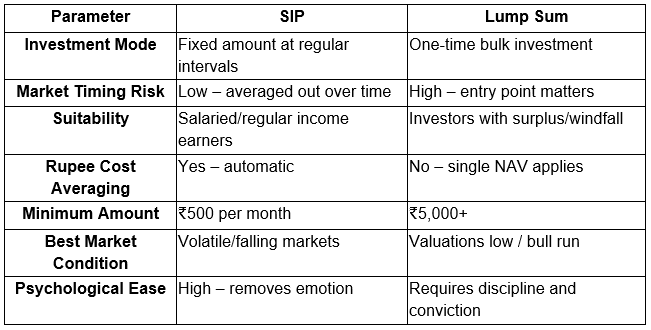
SIP vs Lumpsum - Key Differences
2026 Market Context - SIP Wins for Most Investors
After a sharp correction in mid-2025, Indian equity markets have partially recovered. Nifty 50 is trading at a P/E of ~21-22x, close to its long-term average. This zone of uncertainty makes SIP the safer choice.
- SIP removes the anxiety of "is now the right time to invest?"
- If markets correct further, SIP buys more units at lower prices.
- If markets rally, your invested units gain in value.
For investors wondering how to start SIP in India, the process is simple:
- Choose a mutual fund scheme aligned with your goals.
- Register online or through an advisor.
- Set up monthly auto-debit from your bank account.
- Track progress through fund statements or apps.
When to Choose SIP
- You are a salaried professional investing from monthly income.
- You are new to mutual funds and want a best SIP investment plan for long-term goals.
- You want to build a retirement corpus or fund your child's education.
- You prefer regular saving habits.
- Markets are near all-time highs or valuations look stretched.
When to Choose Lump Sum
- Markets have corrected significantly (20-30% from highs).
- You have received a windfall - bonus, maturity proceeds, inheritance, or property sale.
- Your investment horizon is 7+ years.
- You are investing in debt or hybrid funds with lower volatility.
The Middle Path - STP (Systematic Transfer Plan)
For large windfall amounts, STP is often the best strategy. You invest the lump sum in a liquid fund and set up monthly transfers into equity funds. This combines the benefits of lump sum and SIP.
Example: Invest ₹10 lakh in a liquid fund. Transfer ₹1 lakh per month into an equity fund. Over 10 months, you average out your entry while earning ~6-7% on the liquid fund balance.
Practical Illustration (2016-2026 Scenario)
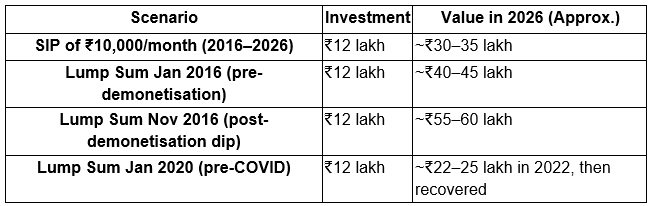
This shows lump sum returns depend heavily on timing, while SIP returns are more predictable and stable.
Best SIP Investment Plan in 2026
For investors seeking the best SIP investment plan, consider:
- Large Cap Funds - Stability and steady growth.
- Mid Cap Funds - Higher growth potential with moderate risk.
- Flexi Cap Funds - Diversification across market segments.
- ELSS Funds - Tax-saving benefits under Section 80C.
Combining these categories ensures balanced risk and reward.
SIP Investment for Beginners - Step-by-Step
If you're new to mutual funds, here's how to begin your SIP investment for beginners journey:
- Learn what is SIP and how it works.
- Define your financial goals (retirement, education, home purchase).
- Choose the best SIP investment plan based on risk appetite.
- Start small - even ₹500 per month builds discipline.
- Increase SIP amount as your income grows.
- Stay invested for the long term to benefit from compounding.
Eastern Financiers - Helping You Decide
At Eastern Financiers, we guide investors with personalized recommendations. Whether you're exploring SIP investment for beginners or evaluating lump sum strategies, our advisors help you choose the right path.
Not sure which approach suits you? Use our free Goal Planning tool at easternfin.com/tools/goal-planning or speak to our experts today.
FAQ's
Q. What is the difference between SIP and lump sum investing?
A. SIP invests a fixed amount at regular intervals, while lump sum investing puts a large amount into a fund at one time. SIP spreads out risk over time, while lump sum depends more on market entry.
Q. Which is better, SIP or lump sum?
A. Neither is universally better. SIP is usually better for salaried investors and uncertain markets, while lump sum may suit investors with surplus cash and a favorable market entry point.
Q. When should I choose SIP over lump sum?
A. Choose SIP if you want disciplined investing, lower market timing risk, and regular contributions from income. It is especially useful in volatile markets.
Q. When is lump sum investing better?
A. Lump sum investing can be better when you have a large amount of surplus money and market valuations are attractive. It may also suit investors with a strong conviction and longer time horizon.
Q. Does SIP reduce market timing risk?
A. Yes, SIP reduces market timing risk because the investment is spread across different market levels over time. This helps average out the purchase price.
Q. Can beginners invest in lump sum?
A. Beginners can invest in lump sum, but SIP is often easier to manage because it reduces emotional decision-making and lowers the pressure of choosing the perfect entry point.
Q. Is SIP better in volatile markets?
A. Yes, SIP is often preferred in volatile markets because it allows investors to buy more units when prices are lower and fewer units when prices are higher.

 Login
Login






 Register on SCORES Portal LEDO