Every year, as the financial year comes to a close, many Indian taxpayers look for smart ways to save tax under Section 80C. While PPF, NSC, tax-saving FDs, and NPS are familiar options, ELSS continues to stand out because it combines tax benefits with equity growth potential. For investors in the old tax regime, best ELSS funds India remain one of the most effective choices for tax-efficient wealth creation.
In 2026, the Section 80C deduction applies mainly to those opting for the Old Tax Regime. If that is you, understanding tax saving mutual funds and how ELSS works can help you make a stronger investment decision. In this guide, we explain what ELSS is, compare it with other tax-saving options, and highlight the best ELSS funds for 2026.
What is ELSS?
ELSS, or Equity Linked Savings Scheme, is a category of mutual fund that primarily invests in equities and qualifies for tax deduction under Section 80C up to ₹1.5 lakh per year. It is one of the most popular elss tax saver fund options for investors who want tax benefits along with long-term growth potential.
Key features of ELSS
- Short lock-in period
ELSS has a lock-in period of 3 years, which is the shortest among all Section 80C investment options.
- Market-linked returns
Because ELSS invests in equity markets, returns are not fixed. Over longer periods, ELSS funds have historically delivered attractive growth.
- Tax efficiency
Long-term capital gains above ₹1.25 lakh are taxed at 12.5%, which keeps ELSS efficient from a tax perspective.
SIP or lump sum
You can invest in ELSS through SIP or lump sum, and each SIP instalment has its own separate 3-year lock-in.
If you are searching for the best ELSS funds India, the main advantage is not only the tax deduction but also the opportunity to participate in equity market growth through professional fund management.
ELSS vs Other 80C Options
When comparing tax saving mutual funds with traditional tax-saving instruments, ELSS often comes out ahead because of its return potential and shorter lock-in period.
Comparison at a glance
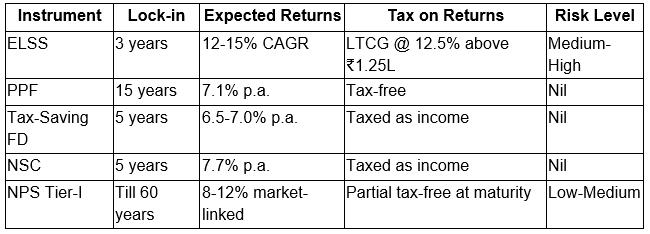
ELSS clearly offers a strong balance of shorter lock-in and higher growth potential. That is why many investors consider it the most practical elss tax saver fund category for long-term tax planning.
Best ELSS Funds for Tax Saving in 2026
Below are some of the most widely tracked options in the ELSS category. These are commonly discussed among the best ELSS funds because of their track record, portfolio quality, and consistency.
- Mirae Asset Tax Saver Fund
A consistently strong fund in the ELSS category, known for quality portfolio construction, disciplined management, and a relatively low expense ratio. It is often suitable for first-time ELSS investors.
- Quant Tax Plan
A high-conviction, data-driven fund with aggressive positioning and strong recent performance. It may suit investors who are comfortable with higher volatility.
- Axis Long Term Equity Fund
A quality-focused ELSS scheme with a long market presence. It has seen phases of underperformance but remains a well-known name in the category.
- Canara Robeco Equity Tax Saver Fund
An underrated but consistent ELSS option, often appreciated for its balanced approach and relatively stable portfolio structure.
- DSP Tax Saver Fund
A diversified and benchmark-aware fund with a solid long-term track record. It is often preferred by investors looking for steadier performance rather than aggressive upside.
If you are comparing the best ELSS funds India, the right choice should depend on your risk profile, investment horizon, and how actively you want to manage the fund.
How to Make the Most of Your ELSS Investment
Choosing the best ELSS funds is only one part of the process. How you invest matters just as much.
- Start early in the year
Do not wait until March. Spread your ELSS investment through SIP across the year instead of rushing at the last minute.
- Stay invested after the lock-in
Once the 3-year lock-in ends, do not redeem automatically. ELSS remains a strong equity investment beyond the tax-saving benefit.
- Keep your portfolio simple
Invest in one or two ELSS funds, not five or six. Too many funds can create duplication and reduce clarity.
- Review annually
Check performance, portfolio quality, and consistency once a year, but avoid frequent switching because of temporary underperformance.
- Think beyond tax saving
A good elss tax saver fund should help you build long-term wealth, not just reduce taxable income.
For most investors, the best ELSS funds India are those that combine tax efficiency with sound equity exposure and long-term consistency.
What is ELSS Under the New Tax Regime?
Under the New Tax Regime, the Section 80C deduction is not available. That means the tax-saving benefit of ELSS is mainly relevant for investors who still choose the Old Tax Regime.
However, ELSS remains valuable as a pure equity investment product. Its core strengths - diversification, professional fund management, and long-term growth potential - stand on their own. So even if tax deduction is not your main goal, a well-managed elss tax saver fund can still be a useful part of a long-term portfolio.
Who Should Invest in ELSS?
ELSS can be a smart choice for:
- Salaried individuals in the old tax regime
They can use ELSS to claim Section 80C benefits while staying invested in equity markets.
- Long-term investors
Those with a 3-year-plus horizon can benefit from market-linked growth.
- First-time equity investors
ELSS provides an easy entry into equity mutual funds with a tax advantage.
- Investors who prefer SIP discipline
Regular SIPs in ELSS can help build a tax-efficient investing habit.
If you are looking for the best ELSS funds in 2026, start with funds that match your risk appetite and long-term goals rather than only chasing past performance.
Final Thoughts
In 2026, ELSS remains one of the most attractive tax-saving options for investors in the old tax regime. It offers the shortest lock-in among Section 80C choices, equity-linked growth potential, and strong tax efficiency. That is why many investors continue to search for the best ELSS funds India and compare different tax saving mutual funds before the tax season ends.
If your goal is not only to save tax but also to create wealth over time, a well-chosen elss tax saver fund can be a strong addition to your portfolio. The key is to stay invested, review annually, and choose a fund that matches your risk tolerance and financial plan.
Save tax and build wealth simultaneously. Invest in ELSS through Eastern Financiers today.
FAQ's
Q. What is ELSS and how does it help save tax?
A. ELSS stands for Equity Linked Savings Scheme. It is a tax-saving mutual fund that qualifies for deduction under Section 80C and also offers equity-linked growth potential.
Q. Which tax regime allows Section 80C benefits for ELSS?
A. Section 80C benefits for ELSS are available mainly under the Old Tax Regime. Under the New Tax Regime, the 80C deduction is not available.
Q. What is the lock-in period for ELSS funds?
A. ELSS has a lock-in period of 3 years, which is the shortest among Section 80C investment options.
Q. Are ELSS returns taxable?
A. Yes, ELSS returns are subject to long-term capital gains tax. Gains above the applicable exemption limit are taxed as per the prevailing rules.
Q. Should I invest in ELSS through SIP or lump sum?
A. You can invest in ELSS through either SIP or lump sum. With SIP, each instalment has its own 3-year lock-in, while lump sum is a single investment with one lock-in period.
Q. How is ELSS different from PPF or tax-saving FD?
A. ELSS invests in equities and offers market-linked returns, while PPF and tax-saving FDs are debt-oriented and generally lower risk. ELSS also has the shortest lock-in period among them.
Q. Who should invest in ELSS?
A. ELSS is suitable for salaried individuals in the old tax regime, long-term investors, first-time equity investors, and those who want tax saving with growth potential.
Q. Can ELSS help build long-term wealth as well as save tax?
A. Yes, ELSS can help save tax and also create long-term wealth because it invests in equities and benefits from market growth over time.

 Login
Login





 Register on SCORES Portal LEDO